
How to Demonstrate Staff Competency in Aged Care

As Used & Trusted


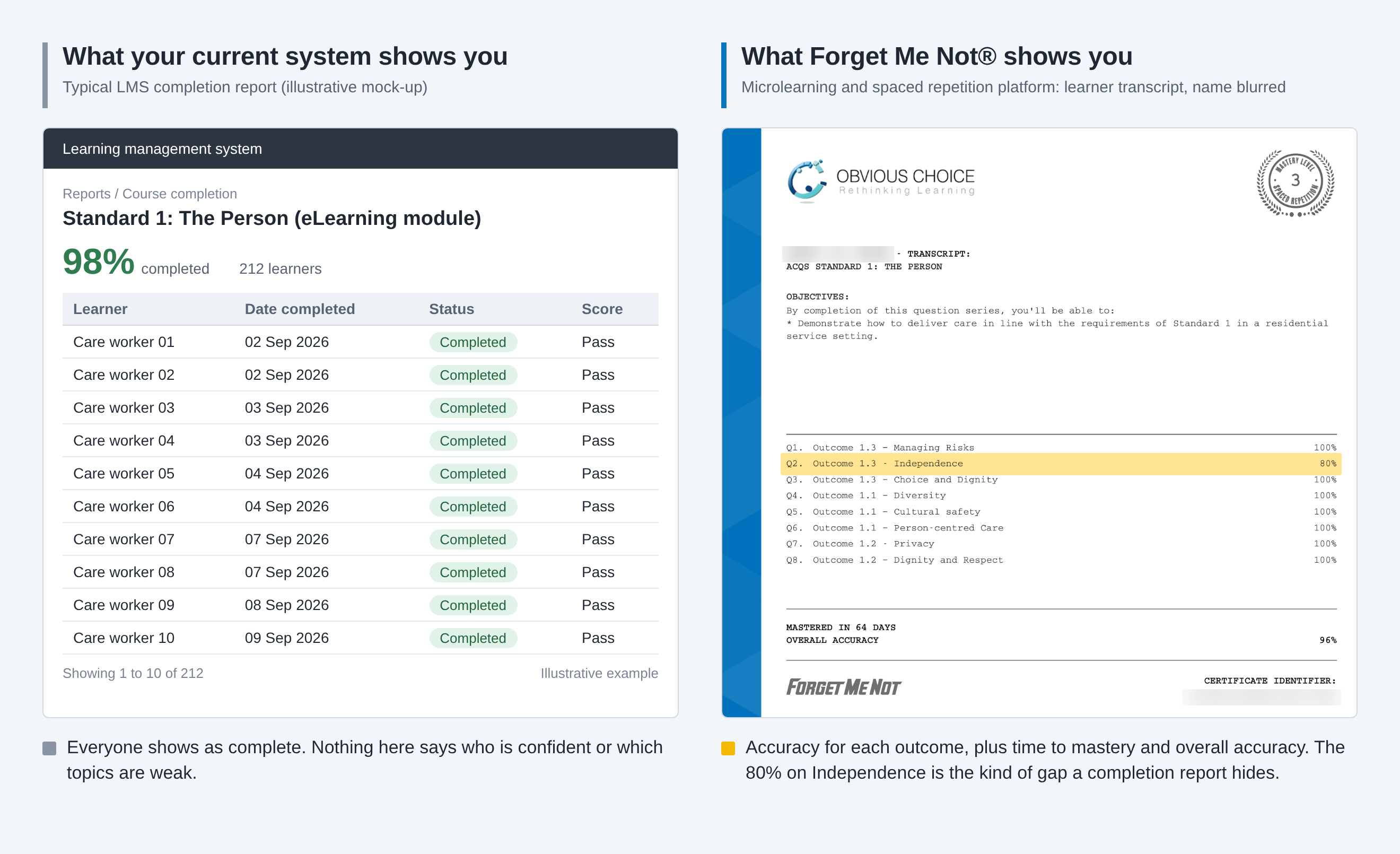
An assessor asks how you know your night staff would handle a medication error correctly. You hand over a report showing 98% of mandatory modules completed. She nods, then asks the question again.
We’ve covered why completion isn’t competency in our post on why compliance training fails. This post covers the harder part: how to measure staff competency, strengthen workforce capability and demonstrate that aged care training is translating into better practice.
Aged Care Training Completion Doesn't Prove Staff Competency
A completion report records that someone finished. It can’t say which questions they hesitated on, which topics haven’t been touched since induction, or whether a team’s grasp of falls prevention is stronger than its grasp of restrictive practices.
Standard 2.9 expects a workforce that is skilled and continuously improving. A flat completion figure shows neither.
Competency evidence has three parts: what staff knew at the start, how that changed over time, and where it’s weakest now.
Measuring Staff Competency Through Ongoing Training
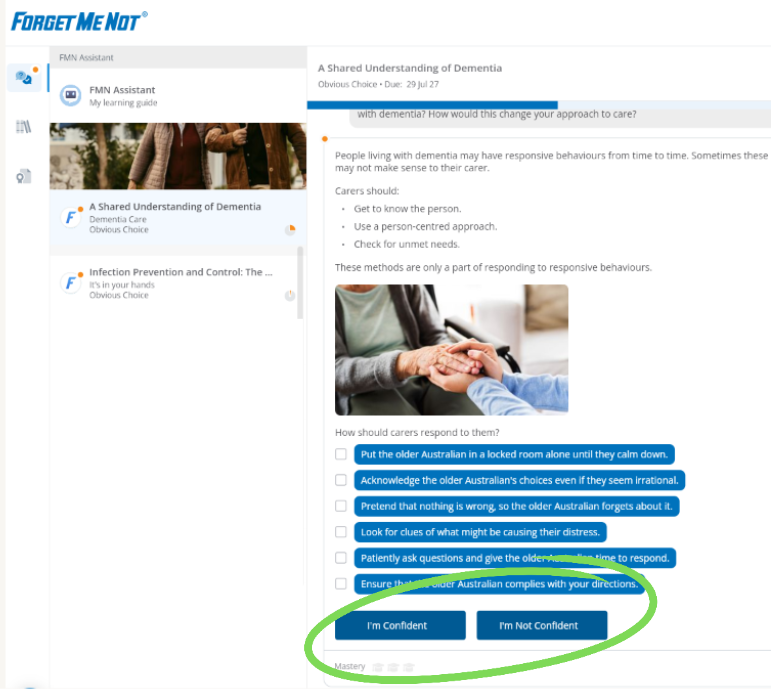
Take a provider with six sites. Staff answer short scenario questions through the week, and each question returns at widening intervals. After a few months the data might show that medication confidence is strong at four sites and slipping at two. Dementia communication is steady everywhere. Infection control was strong at induction but has dropped at three sites since.
None of that appears in a completion report, and all of it can be acted on. The Director of Care at the two medication sites can run a toolbox talk this week, add targeted questions, and check the trend again in a month. A gap is spotted, an action is taken, and the result is measured.
Retrieval is what makes the data honest. Rereading a policy tells you nothing. Answering “a resident refuses their medication, what do you do?” shows what a person can actually pull from memory, which is closer to what they’ll do on shift.
Implement spaced repetition where errors cost you the most
Not every topic needs multiple practice opportunities. Falls, medication, restrictive practices, infection control, dementia communication and incident reporting carry the highest consequences, so they get the most repetition and the closest watching. Lower-risk topics can run on a lighter cycle – a burst of questions to see what people know or don’t know.
Most providers do the opposite by default, because every module in the annual calendar gets equal weight. Equal weight is easy to administer. It doesn’t match where the risk sits.
Combining Competency-Based Training With Practical Skills Assessment
Some skills can’t be proven by answering a question – they need to be observed in practice. Wound care, manual handling and continence care need an assessor observing competency. The strongest evidence pairs both: knowledge data from regular scenario based questions, and an observational skills assessment. When both sit in one place, rather than a spreadsheet and a folder of paper forms, an assessor can see the full picture in minutes.
Managers can use the same data. If confidence in continence care is slipping on night shift, the team leader can raise one scenario question at handover and let the team talk it through for two minutes. The data shows where to look, and the conversation reinforces the learning.
Boards and Assessors Need to See Evidence of Staff Competency
Boards don’t need totals. They need trend: where confidence is lowest, what changed since last quarter, and which actions followed.
Assessors want a chain they can follow. A gap was identified, a specific action was taken, and the result was measured. That chain is what separates a provider with a risk based training system.
“98% completed” invites a nod. “Confidence in medication management dropped at two sites last month, and here’s what we did about it” invites a different conversation, and a better one.
Three questions before your next audit
How do we know what staff knew when they started?
Where is confidence slipping right now?
What did we do the last time we found a gap?
If you can’t answer the third, you have data but the loop isn’t closed.
Forget Me Not® is an enterprise learning platform that keeps your training evidence in one place. It lets you assess skills in the flow of care, track face-to-face sessions alongside microlearning, and build the evidence you need for unannounced regulator visits. Learning is spaced at regular intervals to embed critical job knowledge, without taking people off the floor.
Blog Related


The 5-Minute Mentor: Evidence-based Learning Insights
Transform your team with monthly microlearning insights you can implement immediately.
