
Three tactics to enable microlearning in the flow of care

As Used & Trusted


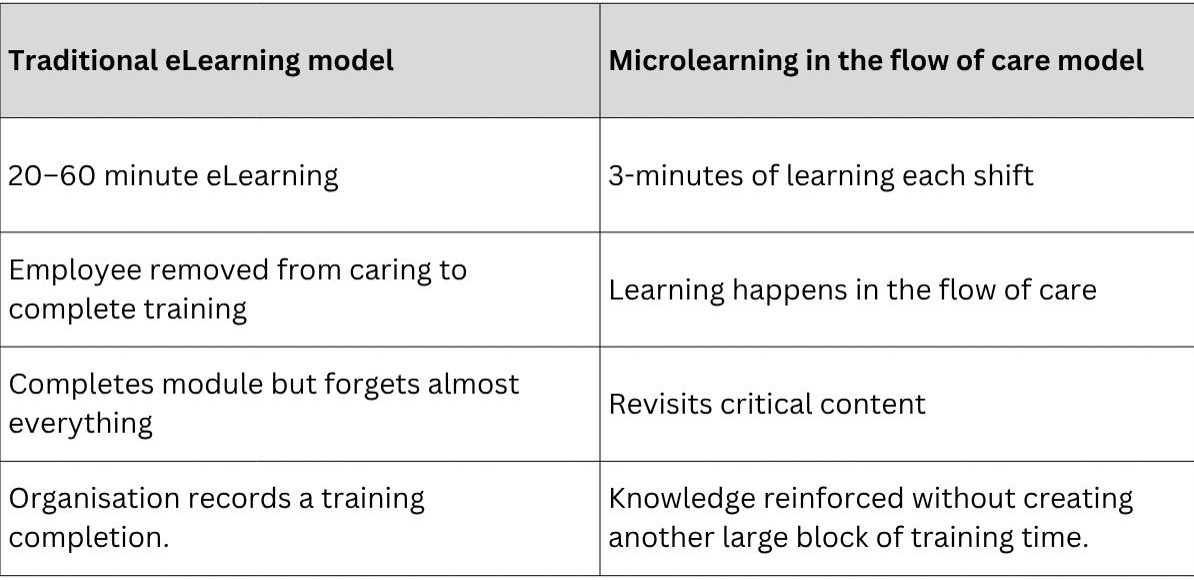
Most aged care providers still remove nurses and care workers from productive care time, to complete 20–60 minute eLearning blocks. The module may be online rather than classroom-based, but the economic model is still built around taking people away from caring to learn.
There is a more effective alternative to meet training compliance and upskill the workforce without compromising care minutes.
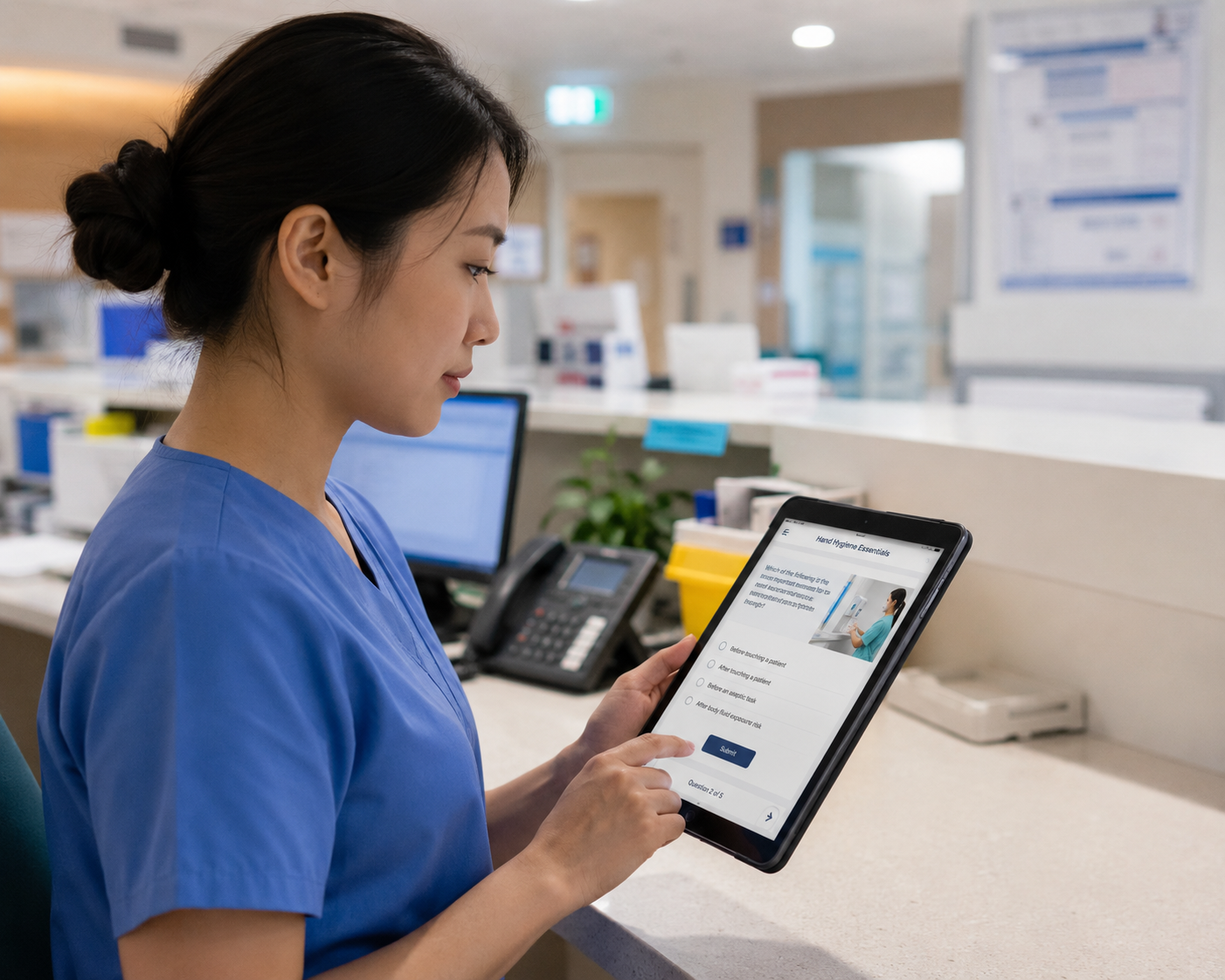
A care worker finishes charting with the work supplied device in their hand. Before their next task, they spend 3 minutes learning about trauma aware and healing informed care.
It sounds simple. But that scenario depends on something that is easy to overlook: access.
We’ve worked with providers for the better part of a decade implementing microlearning. Here are our three tactics to make microlearning work wherever you are on your IT transformation journey.
Tactic one: deliver microlearning on devices you've already issued
A growing number of providers have transitioned their care software to handheld devices like phones and tablets. Care workers and nurses log on and use these devices for the entire shift for point-of-care documentation.
The hardware for microlearning is already in place – it simply requires adding the microlearning application to the device and enabling single sign on (SSO).
Three minute learning opportunities are easily within every care worker’s grasp.
For organisations already operating this way, it is probably the most frictionless approach to implementing microlearning.
The next couple of tactics are more suitable for providers still relying on paper documentation, one training PC or no personal mobile phone use during shifts.
Tactic two: Make BYOD work with clear boundaries
The second tactic is to allow staff to access microlearning on their own phones.
On paper, this is perhaps the simplest approach. Almost everyone has a smartphone, and there is no additional hardware to purchase, deploy or maintain. The challenge isn't the technology. It's creating clear boundaries around when personal device use is appropriate at work.
Staff need to know they are permitted to use their phone for learning during working hours. Just as importantly, managers need to recognise the difference between legitimate learning and personal phone use.
A clear BYOD policy can establish those expectations. Providers can also designate learning zones within a facility — places where staff can spend a few minutes completing microlearning and where phone use for learning is understood and supported.
This makes personal devices a practical gateway to learning in the flow of care without requiring another technology investment.
But BYOD won't suit every workforce or workplace. That's where the third tactic becomes important.

Our research with ARIIA in 2023 led us to explore another approach: taking the technology to the workforce through dedicated microlearning stations.
Tactic three: bring learning to the workforce
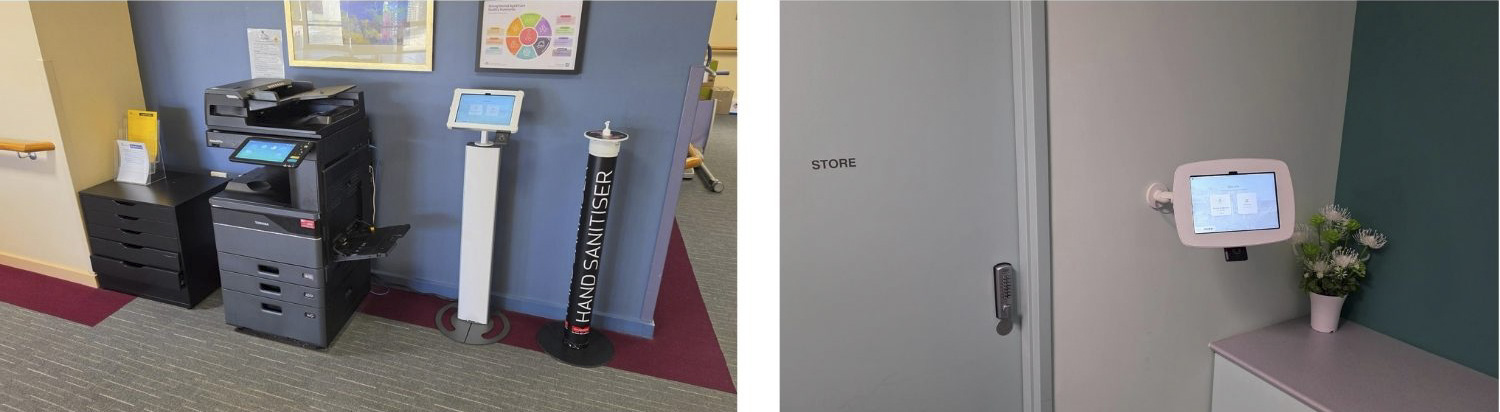
Not every provider has point-of-care devices or wants staff using personal phones. That's why we developed microlearning stations through our research with ARIIA.
A microlearning station is a dedicated learning point in a staff area. Workers simply tap their existing building access swipe card to authenticate — no usernames, no passwords and no separate login process.
That single design decision removes one of the biggest barriers to workplace learning. When a nurse or care worker has three spare minutes, learning is immediately available.
Instead of searching for a device or waiting for a shared computer, staff walk up, tap their card and start learning within seconds.
Microlearning stations work particularly well wherever work happens, nursing stations, kitchens, close to reception and other shared spaces where technology is already part of the working day.
The bigger opportunity: rethink the training delivery model
Once access is solved, providers can ask a more important question:
Why are we still taking nurses and care workers away from care to complete 20–60 minute eLearning modules?
There will always be learning that requires dedicated time — complex skills, facilitated discussion, practice and formal assessment among them.
But conventional eLearning has become the default response to far too many workforce training needs.
For knowledge that staff need to remember and apply in everyday care, there is a better alternative: deliver learning in short bursts, revisit critical knowledge over time and use spaced repetition to strengthen recall.
That changes both the learning model and the economics of training.
An eLearning strategy doesn't just cost the licence fee. Providers also pay for the workforce hours required to consume the training, the administration needed to chase completion and, in some circumstances, the backfill or lost care capacity created when employees step away from caring.
Microlearning creates the opportunity to move much of that learning into the working day — three minutes at a time — rather than continually creating larger blocks of training time.
For CEOs, COOs and Chief People Officers, that leads to a useful exercise:
Calculate how many paid workforce hours your organisation spent completing eLearning last year.
Then ask a different question:
How much of that learning genuinely required employees to leave the flow of care?
If the answer is a large proportion of it, there is a significant opportunity to give productive care time back to the organisation by adopting a learning approach designed around reinforcement and retention rather than one-off completion.
Don't buy another library. Change the model.
The decision facing providers is no longer simply which eLearning library or LMS to purchase.
It is whether a training model built around long-form modules and completion records is still the right model for a workforce under increasing pressure to meet care minutes and demonstrate real evidence of competency.
Microlearning and spaced repetition make another operating model possible: short learning in the flow of care, repeated over time, with less disruption to the workforce.
And implementing it doesn't require every provider to have the same technology environment.
1. Use the devices already in workers' hands.
2. Enable BYOD where appropriate.
3. Put microlearning stations into the workplace where neither option works.
The access problem is easily solved.
The bigger question is whether your organisation is ready to stop treating eLearning completion as the default way to build workforce capability.
Explore what a different training model could look like
Forget Me Not® was designed specifically to help providers move from conventional blocks of eLearning to microlearning and spaced repetition delivered in the flow of care.
Before renewing another conventional eLearning model, calculate the workforce hours it consumes. Then talk to us about how many of those hours could be returned to care.
Blog Related



The 5-Minute Mentor: Evidence-based Learning Insights
Transform your team with monthly microlearning insights you can implement immediately.
