How Spaced Repetition Supports Better Workforce Outcomes

As Used & Trusted


Simple explanation of how memory works and why daily doses of microlearning embed safe, consistent, and high-performing workplace practices.
Workplace training is often treated as a compliance exercise. Staff complete a module, tick the box, and move on. But real competency doesn’t depend on course completion, it depends on whether people can remember what to do in the flow of work.
And that's a problem, because the brain doesn't work the way most training assumes it does.
The forgetting problem
Professor Price Kerfoot from Harvard University was one of the first educators to demonstrate this gap formally. His research showed that individuals tend to forget more than they remember after a single learning event. The issue is not that employees are disengaged or unwilling to learn. It’s that the brain is designed to prioritise information it uses repeatedly and discard information it doesn’t.
The numbers are stark. Without reinforcement, people lose roughly 50% of newly learned information within an hour. Within 24 hours, up to 70% is gone. By the end of a week, retention can fall below 10%. German psychologist Hermann Ebbinghaus mapped this as the forgetting curve in the 1880s, and 140 years later, most workplace training is still designed as if it doesn't exist.
Research presented by Dr Britt Andreatta at the 2026 AITD National Conference makes the scale of the problem hard to ignore. Embedding new behaviour may require 40 to 50 repetitions. Establishing it as a genuine habit, something that holds under pressure, takes closer to 66. Annual training doesn't get anywhere near that threshold. Neither does a once and done workshop!
Under pressure, people don't fall back on their most recent training. They fall back on their deepest habits. For workers operating in fast-moving, high-pressure environments, that creates real risk for organisations and teams.
The spacing effect
Kerfoot's response to the forgetting problem was to apply what's known as the spacing effect. The concept is straightforward: instead of asking people to absorb information once in a large block, you challenge them to remember it repeatedly over time.
The mechanics work like this. An employee receives a short question or scenario. They attempt to recall the correct response. If they get it right, the interval before the next recall challenge expands. Get it right again, and the interval expands further. Struggle, and the concept comes back sooner. Each retrieval strengthens the memory pathway. Over time, critical knowledge becomes genuinely embedded rather than temporarily held.

This is fundamentally different from what your eLearning does. A multiple choice question at the end of a module asks people to recognise an answer, not retrieve one. Recognition and retrieval are not the same thing. Retrieval is what employees need in the middle of real work situations.
The testing effect
The second principle behind this approach comes from Professors Robert Bjork and Elizabeth Bjork at UCLA, whose research demonstrated consistently that one of the most effective ways to strengthen learning is to ask someone a question and require them to attempt an answer.
This is the testing effect. Not a test at the end of an assessment sense but the act of retrieval itself as the primary learning event. Attempting to recall information strengthens memory more effectively than re-reading content.
Done well, this requires adaptive feedback. Employees who struggle with a question need a response that's supportive and builds understanding. Employees who answer correctly need something that extends their thinking. The questioning isn't the end of the interaction; it's the beginning of it.
What this means in practice
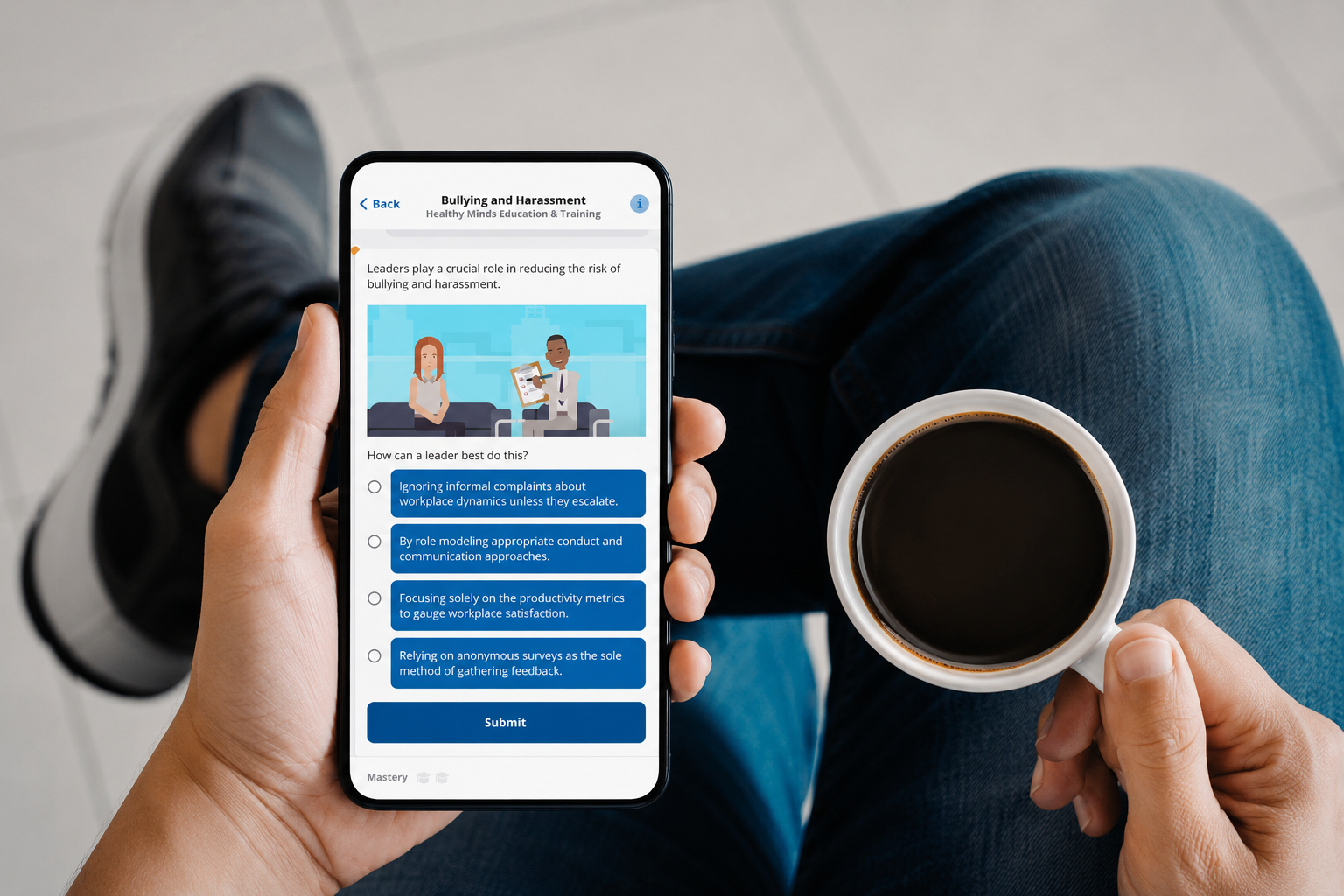
Daily microlearning built on these two principles looks nothing like traditional training. Instead of pulling people away from work for a block session, learning happens in the flow of work. 3-5 minute interactions. Practical scenarios. Short recall challenges. Feedback that reinforces, corrects, and extends.
Employees are busy. Attention is fragmented. Time away from productive work has a direct operational cost. Microlearning respects that reality rather than ignoring it.
For organisations, the data generated by this approach offers something annual eLearning can't: visibility into where capability gaps actually exist. Which concepts are staff struggling with? Which teams need additional support? How is confidence changing over time? That information lets organisations address problems before they become compliance issues, safety incidents, customer experience failures, or performance concerns.
Regulators increasingly expect evidence of competence, not just evidence of completion and attendance. Spaced repetition gives providers a continuous capability model rather than a completion record.
Every hour spent pulling staff into classrooms or lengthy eLearning modules comes at an operational cost. In sectors already dealing with workforce shortages, rising labour expenses, and increasing performance pressure, traditional eLearning isn’t sustainable. Organisations need approaches that improve workforce capability without removing people from their work.
The client experience
Clients and customers don’t experience your learning strategy. They experience the capability of your workforce.
They experience the confidence of frontline employees, the consistency of service delivery, the quality of communication during high-pressure moments, and whether staff can respond effectively when something goes wrong.
There’s a deeper layer here too. Learning scientists describe identity as a person's internal operating system. Under stress, people don't just forget information, they revert to who they believe themselves to be. When situations escalate suddenly, employees don’t have time to “remember the module.” They rely on what has become instinctive. Spaced repetition builds that depth. Tick-box training doesn't.
That’s why workforce capability is a customer experience issue, not just an HR metric. When critical knowledge is reinforced continuously rather than delivered once, employees are more likely to recognise risks earlier, follow best practices consistently, communicate effectively, and perform well under pressure.
Annual eLearning alone won't get you there. There is no evidence it ever has.
Blog Related



The 5-Minute Mentor: Aged Care Learning Insights
Transform your aged care team with monthly microlearning insights you can implement immediately.
